Commercial extinction of the blue whale
The WhaleCommercial extinction of the blue whale marks the point at which industrial whaling had reduced a once abundant species to a remnant population. By the 1960s, the blue whale was, in practical terms, commercially extinct: the scale of killing had exhausted the resource on which the industry depended, though the species had not biologically disappeared. Its decline makes visible the gap between a whale’s value as a commodity and the long-term conditions required for its survival.
Industrial killing and population collapse
The decisive acceleration came with factory fleets capable of processing whales at sea. In iceberg-blocked waters, fleets could kill as many as seventy animals in a day. During the twentieth century, approximately 360,000 blue whales were killed, reducing the population to around 1,000. By the 1960s, the result was commercial extinction: an animal once caught in large numbers had become too scarce to sustain the trade.
The wider figures show how this pressure accumulated. A 1950s animal encyclopedia could place a large Antarctic oil yield beside seasonal catch totals under a separate warning about whales in danger. One reported season included 6,158 blue whales, alongside 17,989 fin whales, 2,108 humpback whales, and 2,566 sperm whales; the account also noted 2,459 whales taken by Russian fleets. The juxtaposition records a shift in outlook, but the warning did not itself halt the catches.
A global industry and its incentives
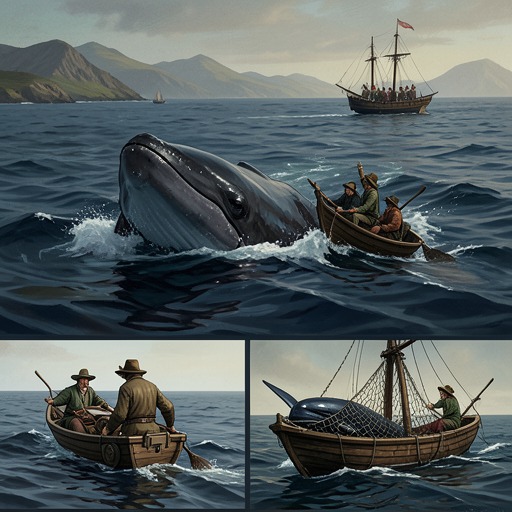
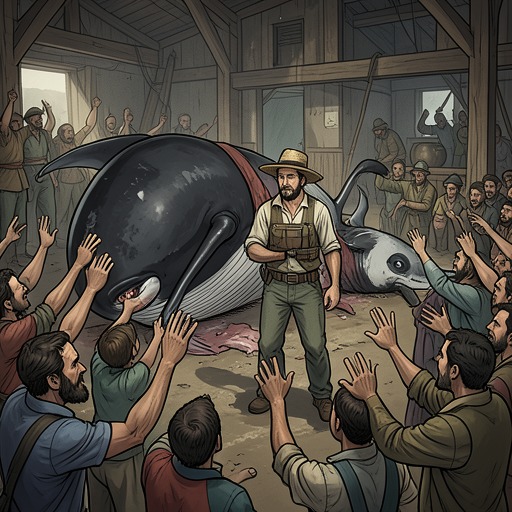
The blue whale’s collapse belonged to a transoceanic commercial system, not to a single port or fleet. Earlier whaling fortunes had already shown how animal bodies could be converted into wealth on shore. In New Bedford, the houses and gardens of prosperous whaling owners were built from proceeds drawn from the Atlantic, Pacific, and Indian oceans. On Nantucket, sperm-whale headmatter passed through a sequence of heating, settling, pressing, and refining to produce spermaceti and, ultimately, white wax. These products illuminate the economic logic behind whaling: processing made the whale’s body useful and profitable, while the resulting demand encouraged extraction on an industrial scale.
By the middle of the twentieth century, the balance of power in whaling had shifted beyond the older New England fleets. In 1951, one year’s worldwide kill exceeded what New Bedford’s whaling ships had taken over a century and a half. The scale of that comparison makes the blue whale’s depletion more than a story of improved hunting capacity: it shows how postwar commercial effort could compress into a short period a level of killing that had once accumulated over generations.
Related declines and continuing risks
The fate of the blue whale appears alongside other signs of population decline, but the species faced distinct risks. The North Atlantic right whale, for example, had fewer than four hundred individuals remaining in the account. It had received protection from hunting in 1935, yet its numbers remained static despite legislation moving a shipping lane north and instructions that vessels keep five hundred yards from whales. A restricted gene pool and deaths from ship strikes and fishing gear further threatened its survival. This comparison shows that ending or limiting direct hunting does not automatically remove the pressures that endanger a population.
The account also stresses that depletion can damage more than the number of animals alive. Research on sperm whales describes complex societies and the transmission of learned knowledge between generations; intensive hunting may therefore remove cultural knowledge along with individuals. That finding concerns sperm whales rather than blue whales, but it broadens the ecological consequence of whaling: population loss can disrupt the social and learned capacities through which animal communities persist.
Commercial extinction and biological survival
Commercial extinction is not the same as the extinction of a species. The remaining blue whales in the 1960s meant that the species still existed, even as its commercial abundance had collapsed. The distinction is central to the account’s history of whaling: an industry can render an animal commercially unavailable long before the last individual disappears. The term therefore records both a biological crisis and the limits of an extractive economy.
The warning extends beyond the blue whale. Between the beginning and completion of the book, the Yangtze River dolphin was declared extinct, while the account projected that many other animal species, including right whales in Cape Cod Bay, might follow. Against that larger pattern, the blue whale’s commercial extinction is not a completed recovery story. It is evidence of how swiftly industrial demand can transform abundance into scarcity, and of how a population may remain vulnerable even after the period of greatest killing has passed.